The Huff–Lamberton House was built in 1857, which makes it older than most of the town around it and a great deal older than us. It is an Italian Villa of brick and stone with a tower on its front corner, listed on the National Register of Historic Places in December 1976. Kappa Chi owns it outright.
Two families built and kept this house across its first century. Neither of them lost it the way the story usually gets told.
The man who named Winona
Henry D. Huff came up the river in 1853, bought into the townsite, and did something that outlasted everything else he did here. The plat had already been surveyed and named Montezuma. In his own words, quoted thirty years later: “With the consent of Capt. Smith I erased the name of Montezuma and inserted the name of Winona on the plot.”
He built this house four years after that, and he named the streets around it for his own family — Huff for himself, Harriet for his wife, Wilson for his son. The 1883 History of Winona County called him the settler who “accomplished so much by his individual efforts to build up the city of Winona.”
The story people tell is that the Panic of 1857 ruined him and he lost the house. He did not. He lived here for about sixteen more years and built a $25,000 flouring mill in 1867. The county history says plainly that “Mr. Huff sold out the most of his property here about ten years ago and went to Chicago.” He lost his money in Chicago, not in Winona, and he died there in January 1889.
The banker's house
Henry W. Lamberton bought it around 1872. He was a lawyer from Carlisle, Pennsylvania who came to Winona in 1856, won election as the city's first city attorney the following year, founded the Winona Deposit Bank in 1868 and ran it until he died, and served two terms as mayor. The Moorish porch that people photograph is his addition, put on in the 1870s.
He and Margaret raised five children here. She died in 1902 and he died on the last day of 1905, in this house. The family kept it for roughly eighty‑three years and four generations, letting go only in 1956.
Winona, August 1889
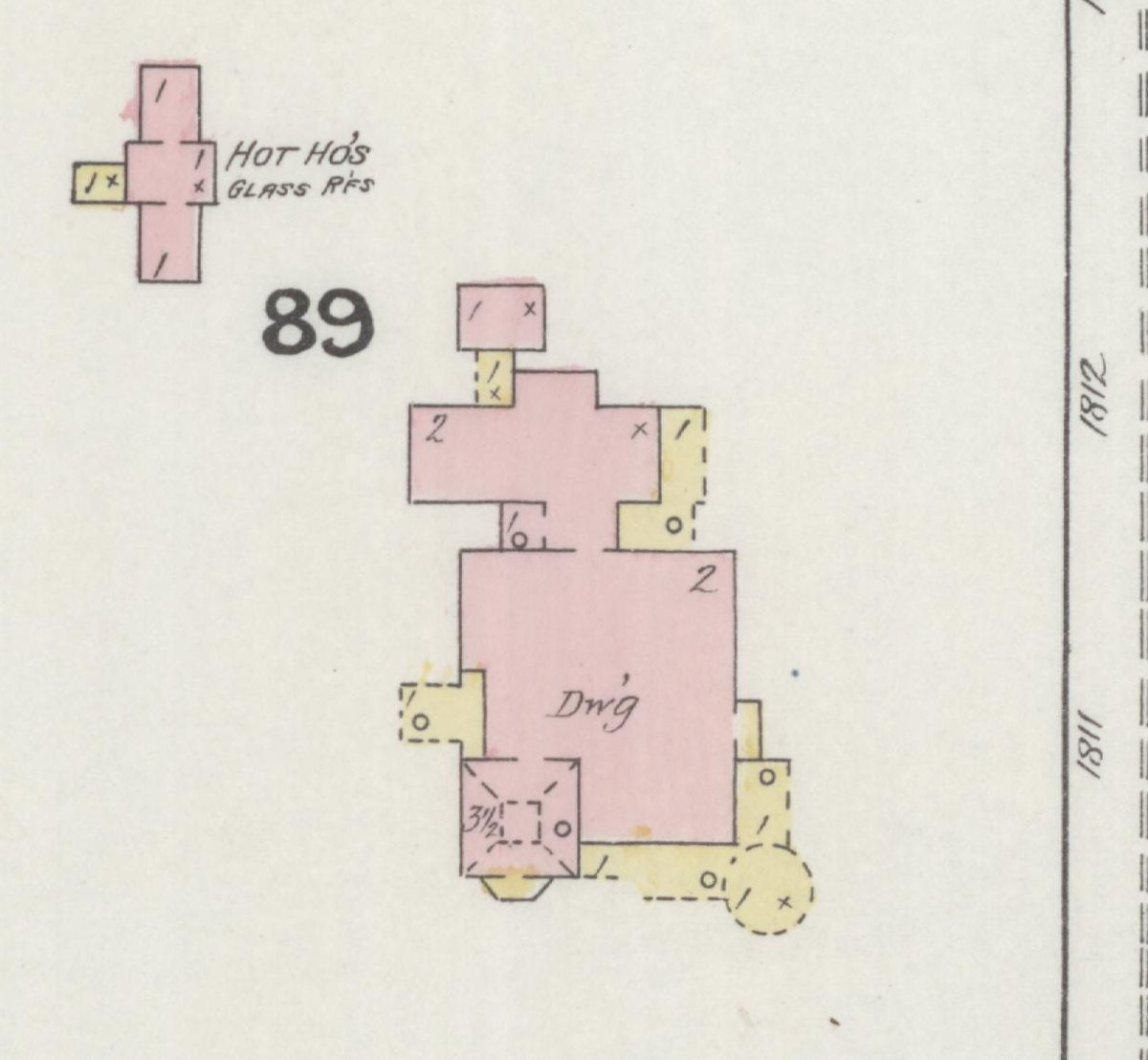
Before the house
The ground was not empty when Huff arrived. The 1883 county history records that “the high ground near the present residence of Mayor Lamberton was the dancing-ground of the Wah-pa-sha band, and… the scaffoldings for the dead were in the immediate vicinity.” It says near, and so do we.
The same book records what happened to those dead. When the treaty was settled and the Dakota understood that settlers were coming, “many bones of the dead were removed and buried in secret places at night, lest they should be disturbed by white settlers.” Where they went is not written down anywhere, because not being found was the entire point.
It is worth knowing whose ground this was before it was anyone's address.
What everyone gets wrong
Ask around the house long enough and someone will tell you about the crypt in the basement, emptied when the original family was dug up and moved. It makes a good story on a winter night and there is nothing to it. The National Register survey inventoried the outbuildings in 1976 and listed “a two storey carriage house, root cellar, and remnants of a formal garden.” A root cellar. For potatoes. Nobody was ever buried here, so nobody was ever moved. The Huffs and the Lambertons are in Woodlawn Cemetery across town.
The truth is better anyway. While the house sat unsold in the late 2000s, a buyer from California proposed turning it into an upscale crypt — for pets. Ten to fifteen thousand dollars to lay your dog to rest in the mansion. The listing agent told the local paper about it and added that the buyer “weren't quite confident enough to actually buy it.” So a crypt really was planned for this building, and it really is empty, because it was never built.
One more, and this one is true. The acre that became the front yard belonged to a settler named Burns, who set out a few apple trees he had carried up the river — “the first fruit-trees, or trees of any kind, planted on Wabasha prairie.”
In our keeping
After the Lambertons the house went to the Catholic Diocese and spent the 1960s as an orphanage, then served for years as an assisted living home, then passed to a private owner. Kappa Chi bought it in May 2023.
It holds our brothers now, which is the fourth or fifth thing it has been. We are the ones responsible for handing it on in better shape than we found it, and for getting its history right — including the parts that are not about us.
Sources
- History of Winona County, 1883 — full text
- National Register nomination, ref. 76001080 — Minnesota Historical Society, 1976
- Sanborn Fire Insurance Maps, Winona — Library of Congress, public domain
- Winona Post — contemporary reporting on the house